
Renting in Italy: Best Websites, Fees & Deposit Guide
Compare rental websites in Italy and understand deposits, booking fees and upfront costs. Use our practical checklist before paying or signing a contract.
Published · Updated
No automatic rent cut has been introduced. The proposed 2027 Budget would reduce landlord tax on eligible agreed-rent contracts; final eligibility and start-date rules still need confirmation.
A proposed tax cut for landlords. A possible benefit for tenants. Here is what the announcement actually means.
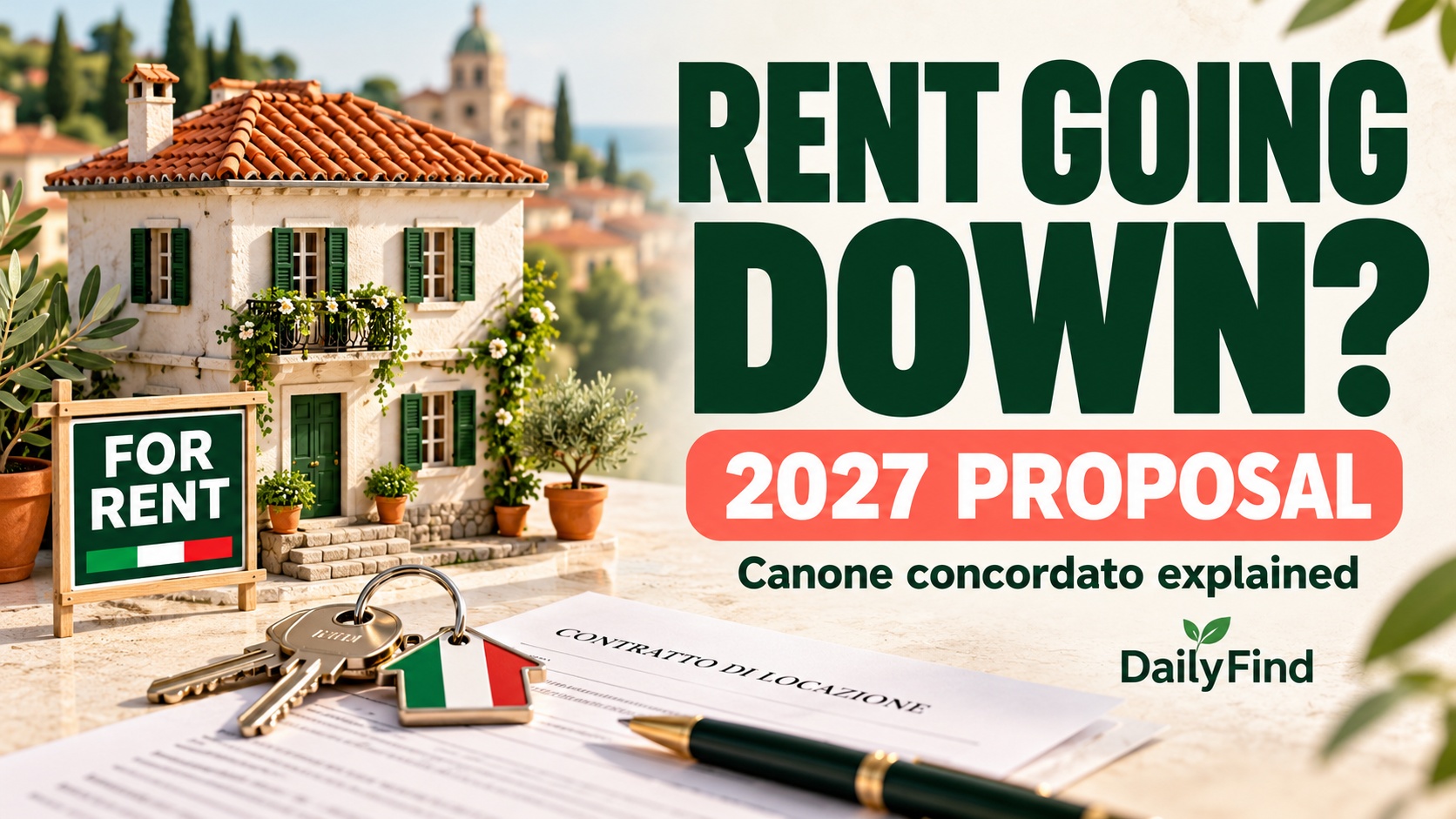
A 1% tax rate for renting to young people sounds like a breakthrough. But if you are hoping your landlord will cut next month’s rent, pause before celebrating.
The Meloni government has announced a proposal to reduce the tax landlords pay on eligible agreed-rent contracts. The immediate financial benefit would go to property owners; cheaper rents and more homes on the market are the intended results.
Following the Council of Ministers meeting on 28 October 2026, Giorgia Meloni announced two proposed reductions to cedolare secca on eligible canone concordato rentals:
| Rental arrangement | Current rate | Announced proposal |
|---|---|---|
| Eligible canone concordato | 10% | 5% |
| Eligible canone concordato rented to young people up to 35 | 10% | 1% |
| Ordinary residential canone libero | Generally 21% | No reduction announced under this measure |
These are tax rates on the landlord’s rental income. They are not percentages used to calculate a tenant’s rent.
The final law must establish eligibility, commencement and transitional rules. [1] [2] [7]
With a typical canone libero contract, commonly lasting 4+4 years, the parties agree the rent freely.
With canone concordato, commonly a 3+2 contract, the rent follows a local agreement between landlord and tenant organisations. Permitted ranges depend on factors such as the location, size and characteristics of the property.
For someone looking for a home in Torino, this means checking the applicable local agreement and the calculation for that particular apartment. There is no single national “young person’s rent”.
A landlord cannot simply charge an unrestricted market rent, write “concordato” on the contract and automatically qualify. Consult Torino’s official local-agreement guidance. [2] [6]
Cedolare secca is an optional tax regime for qualifying rentals. It replaces ordinary IRPEF and related income-tax additions on the rental income, and generally replaces registration tax and stamp duty on the contract.
It is a tax choice, while canone concordato is a way of regulating the rental agreement and rent. The two work together but mean different things.
Under the existing cedolare rules, the landlord also waives contractual rent updates, including ISTAT inflation adjustments, while the option applies. [3] [4]
Imagine a qualifying agreed-rent apartment costing €700 monthly: €8,400 over a full year.
| Scenario | Annual landlord tax | Rent remaining after this tax |
|---|---|---|
| Current 10% rate | €840 | €7,560 |
| Proposed 5% rate | €420 | €7,980 |
| Proposed youth 1% rate | €84 | €8,316 |
Illustrative calculation before maintenance, other taxes and property costs; assumes full eligibility.
Moving from 10% to 1% would save this landlord €756 a year.
The tenant would still pay €700 unless the rent were changed by agreement or another applicable legal mechanism. The announcement does not give the tenant an automatic right to the landlord’s tax saving.
For landlords: the proposal could make an agreed-rent contract more financially attractive. A lower gross rent may become more competitive after tax, although owners must compare the actual permitted rent and their costs.
For young tenants: it could encourage more owners to offer eligible homes. That is a possible market effect, not a guaranteed discount for every applicant.
For existing tenants: the announcement does not itself change your contract. Whether the new tax rates would cover existing agreements remains unresolved. An ordinary 4+4 contract does not automatically become a qualifying youth agreement.
The real test will be whether more suitable homes become available at rents people can afford—not simply whether the headline tax rate falls. [1] [5]
As of 30 October 2026:
Treat 2027 as the intended year, not 1 January as a guaranteed start date for this specific relief. Check the final published legislation before changing tax payments or making commitments based on the proposed rates. [1]
Meloni’s announcement used fino a 35 anni: “up to 35 years old”.
The final wording needs to clarify when age is assessed, what happens as tenants get older, and how contracts with tenants of different ages are treated. Income, residence and other possible eligibility conditions also need verification.
Do not assume an ISEE limit—or the absence of one—until the definitive rules are available. [1] [5]
If you are searching for a home, ask whether the advertised contract is canone libero or canone concordato. Compare the monthly rent, condominium charges and contract terms.
If you already rent, check your registered agreement before assuming any benefit applies.
If you own a rental property, compare your current after-tax income with a correctly calculated agreed rent. The proposed 1% is worth watching, but it is not yet a rate to apply.
Will rents fall now? No automatic reduction has been introduced by this announcement. Could the proposal help make agreed-rent homes more attractive to landlords? Yes—if approved, with its practical value depending on the final rules and local rental market.
Read our rental platforms, fees and deposits guide, check who pays TARI, or tell us what you need in the DailyFind housing survey.
Legal basis for the existing cedolare regime: Article 3, Legislative Decree 23/2011.
Editorial note: This article distinguishes current rules from an announced proposal. It should be reviewed after the final Budget Law is published. General information, not an assessment of an individual contract.
Compare rental websites in Italy and understand deposits, booking fees and upfront costs. Use our practical checklist before paying or signing a contract.
What’s the 411? Learn 20 English number idioms and slang phrases, with simple meanings, original examples and tips on when to use them in conversation.

Try ten self-imposed GTA 6 challenges, from no-GPS road trips to zero-collision runs. Clear rules, official screenshots and community video searches.
Tell us what you’d like to discover next → · Share your housing needs →